
How to Know Which Router Bit You Need:
Everything You Need to Know About Router Bits
WHAT IS A ROUTER BIT?
TYPES OF ROUTER BIT
Of course, there are many different types of router bit and although they all serve the same general purpose, they each do different things and achieve different results. A good router bit, though, should be sharp, should retain its sharp edge, and should be well balanced; this produces a bit that will last longer and will “chatter” or vibrate less during use. Conversely, bits of lesser quality tend to wear faster, chip easier, and chatter more aggressively. The following, then, is a basic breakdown of how router bits are most commonly categorized and their respective routing applications.
Cutter Type:
For the most part, router bits can be divided into three major types: fluted cutters, profile cutters and helical cutters. Fluted cutters are used for edging and trimming, profile cutters are used for trimming and shaping, and helical cutters, while mostly used in more easily machined (softer) materials, are designed for trimming, shaping and drilling. Of course, within these three groups, bits can be (and are) more specifically categorized – this will be reflected in greater detail below.
Construction:
Similarly, drill bits are usually fabricated with one of three compositions: solid high-speed steel (HSS), carbide tips, or solid carbide. HSS bits are the least expensive; they dull more quickly and, accordingly, are used primarily to trim laminate or for work in softer workpieces. Carbide tipped bits are the most universal bit type as they are more durable and perform (at least) reasonably well in all applications. Of course, these are more expensive than HSS bits, but they are equip to manage harder materials and they retain their sharp edges for longer periods. Solid carbide bits, as one would assume, are the most expensive and highest-performing bit type. While some might argue that their solid carbide construction is superfluous, they are durable and deliver beautiful results. Because of their cost, though, solid carbide bits are generally used by only the most practiced woodworkers.
Router bits can also be classified as edge bits, non-edge bits, or anti-kickback bits. Edge bits include a small wheel bearing which acts as a fence against each workpiece; these wheel bearings can be changed to alter the diameter of the cutting edge. Non-edge bits do not have this wheel bearing and therefore a fence (either attached to the workpiece, the router itself or to the router table) must be used with these bits. Anti-kickback bits, on another hand, feature non-cutting material surrounding the bit’s “shoulders.” This additional girth around the bit limits the material feed rate which, in turn, protects the workpiece from over-eager bit progress. This reduces the risk of kickback which occurs when a bit bites and catches the material it’s cutting. This is usually the result of material feeding too quickly. The girth of ant-kickback bits also allows the bit to stay cooler which reduces the likelihood of burnishing and allows the bit to better retain its sharpness.
Shank:
Router bits are also differentiated by the diameter of their shank or the portion of the bit that fits into the router collet. Shank sizes commonly range from about 1/2” to about 3/8.” Although 1/2” shank bits are typically more expensive, they are also the most popular as the thickness of their shank lends durability (in their stiffness) and also less vibration during use. Bits of a smaller shank diameter tend to be less durable and more chattery. Altogether, a 1/2” shank bit will usually deliver the smoothest cuts and due to their greater rigidity, many larger profile bits are only available with this 1/2” shank. Similarly, some smaller or more specialized bits are only available with a 1/4” shank.
The shank of a router bit and a router collet must have the same diameter to be used together. Of course, collets of different diameters are available for purchase and are frequently included with the router itself. Adapters may also be purchased to help different bit shank sizes fit more comfortably.
Speed:
In order to cut, trim, and shape efficiently, router bits spin at very high speeds (ranging from approximately 8,000 RPM to 30,000 RPM). Because router bits are shaped and sized differently, though, all router bits can not / should not spin at the same speeds. For example, because larger bits have more girth and weight spinning about, they also have a much greater potential to vibrate or be, in some other capacity, out of control. Larger bits, then, should be used at lower speeds. Similarly, bits that spin too slowly can burnish and damage your materials. Accordingly, manufacturer guidelines should always be reviewed and implemented before engaging a bit.
Although, as a generality, faster speeds are more advantageous while working with router bits (they ordinarily yield a much smoother cut), speed isn’t the only factor that contributes to the quality of your cutting results. The sharpness and composition of any given bit, the material being cut, the type of router being used, feed rate, and various other factors play into the results produced by your bits. Accordingly, it will behoove you to run bits at appropriate speeds before assuming the faster you spin them the smoother your results will be.
ROUTER BIT PROFILES AND APPLICATIONS:
As aforementioned, there are numerous bit designs and, according to that profile, each bit has a different specialization. The following, then, briefly sums-up (in alphabetical order) the most common bit types and the things those bits do best.
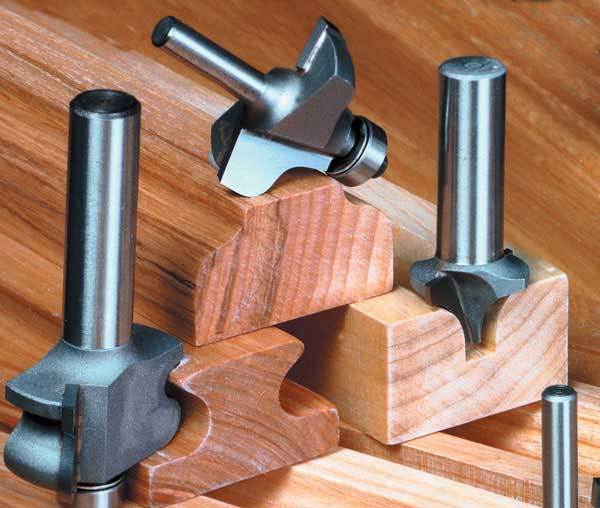
Ball End Router Bits:
As the name indicates, ball end bits have a ball or sphere shaped formation at their bottom which routs out channels for pipes and cables.
Bullnose Router Bits:
Bullnose bits are designed to create a (convex) rounded edge on the front edge of a workpiece.
Chamfering Router Bits:
Chamfering bits produce a clean angled bevel cut. These are commonly used in joinery for concealed joints and beveled edges in constructions with multiple sides. Chamfer bits are also used to create a decorative (albeit plain) angled edge.
Combination Router Bits:
Combination bits are primarily used in trimming to trim softer materials and, particularly, veneers.
Core Box or Round Nose Router Bits:
Core box or round nose bits produce a half-round groove or a groove or cove with a rounded bottom. They are commonly used for fluting and reeding.
Corner Round Router Bits:
Corner round bits are designed to create a rounded corner on a workpiece (usually furniture).
Drawer Lip Router Bits:
Drawer lip bits are used to create the the acting pull-handle on the fronts of pull-handle drawers and cabinets.
Edge Forming Router Bits:
Edge forming bits (like an edge beading bit) are used primarily to create a decorative edge on a workpiece. These bits often include a pilot bearing for guidance and are ordinarily used to create a final decorative feature. Because these bits are almost singularly used for embellishment and can take-on virtually any profile conceivable, there are many different types available. To name a few of the most common edge forming bit types, one will commonly encounter edge beading bits, cove bits, ogee (or Roman ogee) bits and round over bits.
Bead and Double Bead Router Bits:
Bead bits create a decorative quarter-round convex profile. Double bead bits do this twice with one quarter-round running directly below the other.
Cove Router Bits:
Cove bits are used to create a concave (or indented) quarter-round into the edge of a material.
Edge Beading Router Bits:
Edge beading bits are used to cut decorative half-round profiles called “beads” into the edge or corner of a workpiece. This edge typically features a small lip or fillet at the top and bottom of the convex half-circle cut.
Ogee Router Bits:
Ogee bits have an “S” shaped profile and produce an “S” shaped edge on a workpiece. These decorative edges have one convex hump and one concave cove (like an “S”) and usually have a small fillet at the top and bottom of the cut. This delivers a more traditional or “antique” finish.
Round Over Router Bits:
Round over bits produce a perfectly rounded edge on a workpiece. These are commonly used in cabinet and furniture making.
Finger Grip Router Bits:
Finger grip bits shape the drawer pull handles on the front edges of some drawers and cabinets.
Flush Trim Router Bits:
As the name implies, flush trim router bits are used to trim the edge of one material to be flush with the edge of another material. They are often used to flush veneers or to produce identical shapes in multiple workpieces. These bits are used with a pilot bearing that may be positioned at the top of the bit or at the base of the cutting edge.
Fluting Router Bits:
Fluting bits are used to carve flutes (or a concave profile) into a workpiece (usually molding).
Joinery Router Bits:
Joinery bits are used to produce a specialized type of groove for a precision joint. These, then, are used in virtually all types of construction where one workpiece must be joined to another. The most popular joinery bits are dovetail bits, drawer lock bits, finger joint bits, lock miter bits and tongue-and-groove bits.
Dovetail Router Bits:
Dovetail bits are used to create a strong joint between materials and are ordinarily used in cabinetry, frames and shelving. They are available in a huge variety of angles and involve carving interlocking mortises and tenons (usually fan-shaped) into an adjoining workpiece.
Drawer Lock Router Bits:
Drawer lock bits are designed specifically for the joining of perpendicular pieces (like the joining of drawer sides to drawer fronts) and should always be used with a router table. They create a wedge-shaped tenon.
Finger Joint Router Bits:
Finger joint bits have a series of thin horizontal cutters that protrude from the bit (like fingers). When this profile is cut into two separate pieces, the grooves/extensions interlock to create a strong end or edge joint with a greater gluing surface area. Some finger joint bits feature adjustable cutters.
Lock Miter Router Bits:
Lock miter bits have a reputation for being difficult to use but create durable and (when used properly) perfectly aligned miter joints with a large surface area for gluing.
Tongue-and-Groove Router Bits:
Tongue-and-groove bits are used in pairs to create a tongue-and-groove joint in a workpiece. This joins workpieces together edge-to-edge (where one piece has a thin, deep ridge (tongue) and the other has a slot (groove); these pieces are pushed tightly together to form the joint).
Keyhole Router Bits or Keyhole Slotters:
Keyhole bits are used to cut the keyhole shaped slots found on the backs of hanging workpieces like picture frames. These slots, of course, aide in the hanging of these pieces.
Molding Router Bits:
Molding bits are used to create complex ornamental profiles in architectural and furniture moldings and are usually much larger than a typical edge forming bit. They can incorporate multiple profiles onto one bit and produce ornate edging for molding pieces. As these bits are more substantial, they are almost always used with a router table.
Mortise Router Bits:
Mortise bits are used to carve mortises (or square shaped slots). These are used for joinery and for carving spaces for hardware such as hinges and lock sets.
Rabbeting Router Bit:
Rabbeting bits are used to create rabbets or notches in the edge of a material. These cuts/notches are vertically and horizontally straight and create a step shaped profile. Rabbeting bits utilize a pilot bearing which is positioned at the top of the bit and guides it along the edge of a workpiece. Using pilot bearings of different diameters allows one rabbeting bit to produce cuts (rabbets) in multiple sizes.
Raised Panel Router Bit:
Raised panel bits are available in both vertical and horizontal configurations and are typically used (with a stile and rail bit – see below) to create profiled, decorative edges on a panel (i.e doors). Horizontal raised panel bits cut profiles while the panel being cut is flat (horizontal) on a work table. Vertical raised panel bits cut profiles into a panel while said panel is on its edge, and, because their radius is much smaller, are usually considered safer and simpler to operate.
Spiral Router Bits:
Spiral router bits are designed quite like a spiral drill bit with flutes ground around the body of the bit to form a sharp spiral profile. They are available in up-cut and down-cut configurations and, while ideal for plunge cutting, they are also used for edge forming, cutting, and trimming in a variety of materials.
Stile and Rail Router Bits:
In frame and panel construction, stile and rail bits are designed to create ornamental edges and panel slots in the edge of a workpiece (most commonly in raised panel doors and custom cabinets). These ordinarily come in sets of two matched bits but are also available singularly.
Straight Router Bits:
Straight bits come in a variety of cutting diameters and are designed to make straight cuts into a material to hollow-out an area or to produce a grove or dado in a workpiece (usually for a mortise or inlay). Straight bits are very common and may also be used for dado joining and for general material cutting.
V-Groove Router Bits:
V-groove bits are used to carve a “V” shaped groove into a workpiece. While ideal for miter folds, these bits are commonly used in lettering and sign-making.
Veining Router Bits:
Veining bits are designed to create decorative cut-in designs. They are commonly used for free-hand work and lettering.
TIPS FOR OPTIMIZING YOUR ROUTER BITS:
To conclude this journey through router bit basics, the following are a few tips to help you optimize your router bits and your experience with them.
First, you should always store your router bits separately from one another (perhaps even in their own individual cubbies). Because router bits are both heavy and fragile, you want to minimize their contact with anything they are not presently cutting. Don’t allow your bits to roll about bumping and knocking into other objects under which circumstance they will most certainly chip.
Second, keep your router bits sharp. Dull bits can damage your materials and will produce generally poor cuts. Like many other cutters, router bits can be sharpened to keep their edge.
Third, be cautious of how you handle your router. Both forcing a bit and moving one too slowly can cause overheating in both the bit and the router. An overheated bit can damage workpieces and can lose temper (which diminishes the integrity of the bit) and an overheated tool can result in internal and sometime irreparable damage. The sound your tool makes as you cut is usually a fairly good indicator of whether or not you are properly paced.
Posted in “How to” of the Month, Routers, Tool Tips by Mallory Kramer.


Leave a Comment